How to Trace a Pantry Food’s Origin Beyond the Front Label
Trace a pantry food’s origin by separating where ingredients grew from where they were processed, then decide what label details can actually tell you.
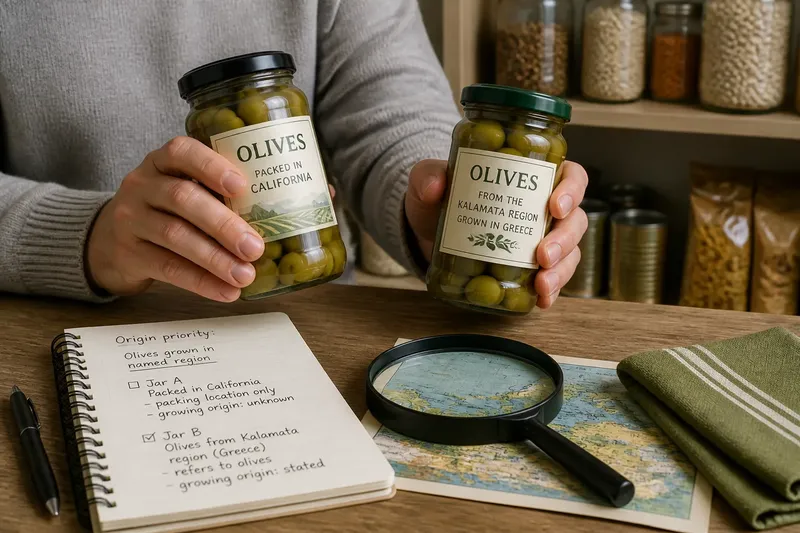
You find “packed in California” on a jar of olives, but the label does not say where the olives grew. Tracing a pantry food’s origin means separating the locations named on a package from the places it leaves unstated.
That distinction matters if you are choosing food based on a growing region, a producer, or a processing location. Each is a different sourcing question, and a label may answer one without answering the others.
Pantry food origin depends on which location you mean
Start by naming the location you want to know. “Where was this product packed?” is not the same as “Where were its ingredients grown?” or “Which producer supplied them?” A country name or place name only helps if it answers the question you are actually asking.
On a jar, can, or bag, look for wording that identifies a specific ingredient or stage of production. A statement about a finished product’s processing or packing location should not be treated as proof of where every ingredient originated.
Read origin wording for its exact scope
Look closely at the words around a place name. Does the package connect that place to the food itself, to an ingredient, or to a processing step? If the wording leaves the connection unclear, record the claim as limited rather than supplying a more specific meaning yourself.
- If the label names a growing region: Check whether it links that region to the ingredient you care about. If it does, use it as a stated geographic clue; if not, look for more precise product information.
- If the label names a country: Check whether it says the food was grown, produced, or packed there. If the action is specified, interpret the country accordingly; if it is not, do not assume it identifies the farm or growing location.
- If the package names a producer: Check whether the producer is tied to the ingredient or only to the finished product. If the relationship is clear, note it; if not, ask the manufacturer what the name refers to.
- If it says “locally sourced”: Check whether the package defines the place, ingredient, or sourcing area. If it does, compare that description with your priority; if it does not, treat the phrase as too broad to settle a precise origin question.
- If a landscape or farm appears in the artwork: Check for matching written origin information. If the text supports the image, use the text; if not, do not treat the illustration as evidence of origin.
- If the label only names a packing location: Check whether it separately identifies where the ingredients came from. If it does, keep the two locations distinct; if it does not, the growing origin remains unanswered.
Say you are choosing between two jars of olives and want olives grown in a named region. Jar A says “packed in California” but gives no growing location; Jar B says the olives are from a specified region and names that region. You check whether Jar B’s wording refers to the olives themselves, then choose it if that is your priority; Jar A’s packing statement remains useful, but it does not answer the same question.
Check the sourcing detail you need?
Does “packed in” tell me where an ingredient was grown?
Not by itself. It identifies a packing location, so look for separate wording that connects a place to the ingredient’s growing or production origin.
Can a country name identify a product’s full origin?
Only to the extent the wording says what happened there. Check whether the country is linked to growing, production, or packing, and do not extend that statement to other stages without supporting information.
What should I do when the package leaves origin unclear?
Check the manufacturer’s product page or contact the company with a specific question, such as where the named ingredient was grown. If the information is not available, keep that uncertainty in view or choose another product whose wording addresses your priority.
Ask manufacturers a question they can answer
A broad request such as “Where does this come from?” can produce an answer that still leaves the relevant detail unclear. Ask about a named ingredient and stage instead: “Where were the tomatoes in this jar grown?” or “Does this country statement refer to packing or production?”
Keep the package wording nearby when you ask, and compare the response with the claim you wanted clarified. If the answer describes a different stage, note that distinction rather than treating it as a complete origin history. Where a claim depends on a formal label definition or local rules, consult applicable official guidance or a qualified professional.
Keep an origin decision tied to the evidence
For pantry food origin, the useful result may be a clear location, a partial answer, or an unanswered question. Each outcome supports a different decision: choose a product that states the location you need, seek more detail, or decide that the available information is not enough for this purchase.
Keep a simple note if you are comparing products later: write down the ingredient or stage you care about and the exact claim that addresses it. That small distinction helps prevent a packing location, a broad sourcing phrase, or attractive package art from standing in for the origin information you actually want.