Per Serving or Per 100 Grams: How to Compare Nutrition Panels Fairly
Per serving or per 100 grams? Learn how the comparison basis changes nutrition figures so you can compare two products on equal terms.
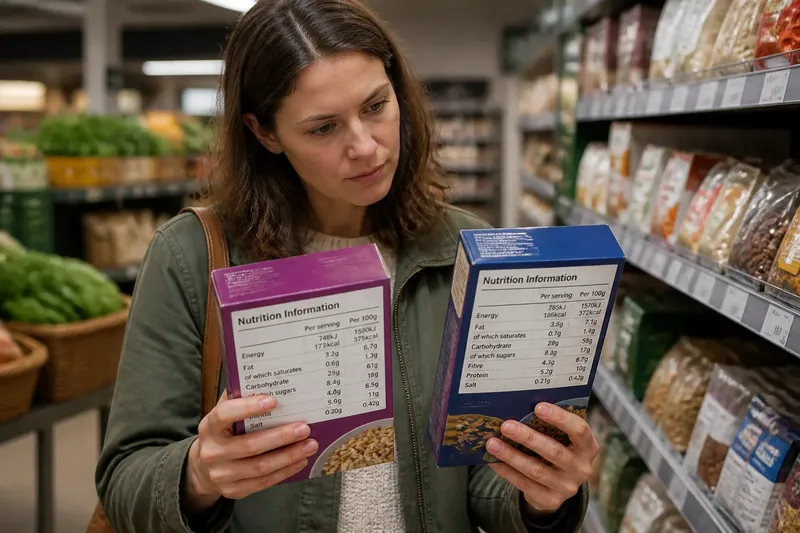
Per serving or per 100 grams—which number answers the question you have about two nutrition panels? The first describes a package-defined portion; the second puts foods on the same weight basis.
Those figures can point in different directions without either being wrong. The useful comparison depends on whether you want to understand a particular portion or compare what the foods contain at equal weights.
Per serving and per 100 grams answer different questions
A per-serving figure tells you the nutrients listed for the serving described on that package. A per-100-gram figure lets you compare the products at an equal weight, even when their serving sizes differ.
Serving sizes are label information, not necessarily instructions for how much to eat. A cereal portion on one panel may weigh less than the portion on another, making its per-serving numbers look lower even if the products are similar by weight.
Say you want to know what a bowlful of cereal would provide, and the amount you typically pour is close to one label’s stated serving. That panel’s per-serving figures may be the more direct reference; if you instead want to compare the cereals’ composition, use their per-100-gram columns.
Use a fixed weight to compare product composition
Per 100 grams gives both products a shared measuring base. It is particularly helpful when packages define unlike portions or when you plan to eat a quantity that does not match either serving description.
Imagine you are comparing two cracker labels. One serving is four crackers and the other is three, but both panels list values per 100 grams. Compare the same nutrient in those columns; the different cracker counts no longer shape the comparison. The answer still describes equal weights, not necessarily equal numbers of crackers.
If a panel has no per-100-gram column, a serving weight can sometimes let you convert the figure. If the label omits information needed for a straightforward conversion, treat that comparison as incomplete instead of filling in the gap with a guess.
Use a serving basis to understand a portion
Per-serving values can be convenient when the labeled portion resembles the amount you want to assess. Read the serving description alongside the numbers: “one cup,” “two slices,” and a stated gram weight may represent different amounts from product to product.
A household measure can also be imprecise. A cup of a loose food may not weigh the same as a packed cup, and slices or pieces can vary in size, so use a printed weight when the comparison calls for one.
If your actual portion is larger or smaller than the listed serving, the per-serving figure does not describe your plate exactly. Keep that difference visible rather than treating the package portion as a personal recommendation.
Make both labels describe the same food and amount
Compare serving with serving, or compare equal weights. Placing one product’s per-serving figure beside another’s per-100-gram figure gives no clean answer because the quantities of food differ.
When one panel provides only serving-based values, check whether it lists the serving weight. If the relevant weights and nutrient figures are available, you can convert both values to a shared basis; otherwise, the labels may not support a direct comparison.
Also check whether the column describes food as sold or prepared. A dry mix and a cooked dish have different weights after liquid or other ingredients are added, so compare them in the same state whenever possible.
Preparation directions do not necessarily include every ingredient you add at home. If you mix in milk, oil, or another food, the final dish differs from the package figure unless the label’s stated preparation already accounts for it.
Check the label details that change the comparison
- Serving description: Check the stated portion; if it matches the amount you want to understand, use the per-serving column, otherwise compare equal weights.
- Serving weight: Check whether a gram or ounce weight is printed; if both weights and nutrient values support conversion, calculate a shared basis, otherwise treat the comparison as limited.
- Column heading: Check whether each figure is per serving, per 100 grams, or for prepared food; if the bases match, compare them, otherwise convert where possible or stop short of a direct comparison.
- Nutrient name: Check that both panels name the same nutrient; if they do, compare that row, otherwise choose a matching row or leave the question unresolved.
- Preparation state: Check whether the values describe food as sold or prepared; if the states match, compare them, otherwise find matching columns or avoid treating the figures as equivalent.
- Your purpose: Check whether you are assessing a typical portion or composition at equal weight; if it is a portion question, use the relevant serving figure, otherwise use a fixed-weight basis.
These checks keep the arithmetic tied to what the panel actually describes. They do not decide which food belongs in your diet; taste, ingredients, dietary needs, and the meal all matter too.
Questions about per serving or per 100 grams?
Is per 100 grams always the better comparison?
No. It is useful for comparing products at equal weight, particularly when serving sizes differ, but it does not directly describe your portion. Use serving figures when the labeled amount is the quantity you want to understand.
Can I compare different household serving measures?
Only with care: a cup, slice, or piece can represent different weights across products. Look for a stated weight and compare equal weights when you want to assess composition.
What if a package has no per-100-gram column?
Check for a serving weight and see whether the label provides enough information for a straightforward conversion. If required figures are missing, regard the comparison as limited rather than guessing.
Should I choose a product because one number is lower?
Not by that fact alone. Confirm that the nutrient and comparison basis match, then consider what matters for your needs and how the food fits into your eating pattern.
For a fair nutrition-panel comparison, keep the purpose and basis together: per serving for a labeled portion, per 100 grams for equal-weight composition. If you remember one thing about per serving or per 100 grams, let it be this: the numbers become useful only after you know what quantity of food each one describes.